
Category: SOC - Investigation - SQL
SQLI UNION Attack Investigation
Investigating and Identifying SQLI Union activity required multiple correlation and analysis, below listed are some few correlation point which get to be used for proceed investigating the SQLI Investigation activity:
- Targeted Investigation of Apache Access Logs
- Identify and Prioritize URLs Associated with SQL Execution
- Unpack the Attack Execution Sequence
1. Preparing the Investigation Environment
Before starting the investigation, ensure all required data sources, dashboards, and tools are prepared. The table below organizes the preparation phase using the format:
| Source | Description | Purpose |
|---|---|---|
| ELK – Apache Access Logs | Primary dataset containing HTTP request logs, user agents, source IPs, URLs, referrers. | To identify suspicious SQL-related GET requests and trace attacker activity. |
| ELK Query Console (Kibana Discover / SIEM Search) | Investigative interface for running advanced Lucene/KQL searches. | To extract, filter, and correlate malicious SQLi indicators. |
| CyberChef (Decode / URL Decode) | External analysis tool to decode encoded payloads. | To decode URL-encoded SQLi payloads for readable analysis. |
2. Step-by-Step Investigation Workflow
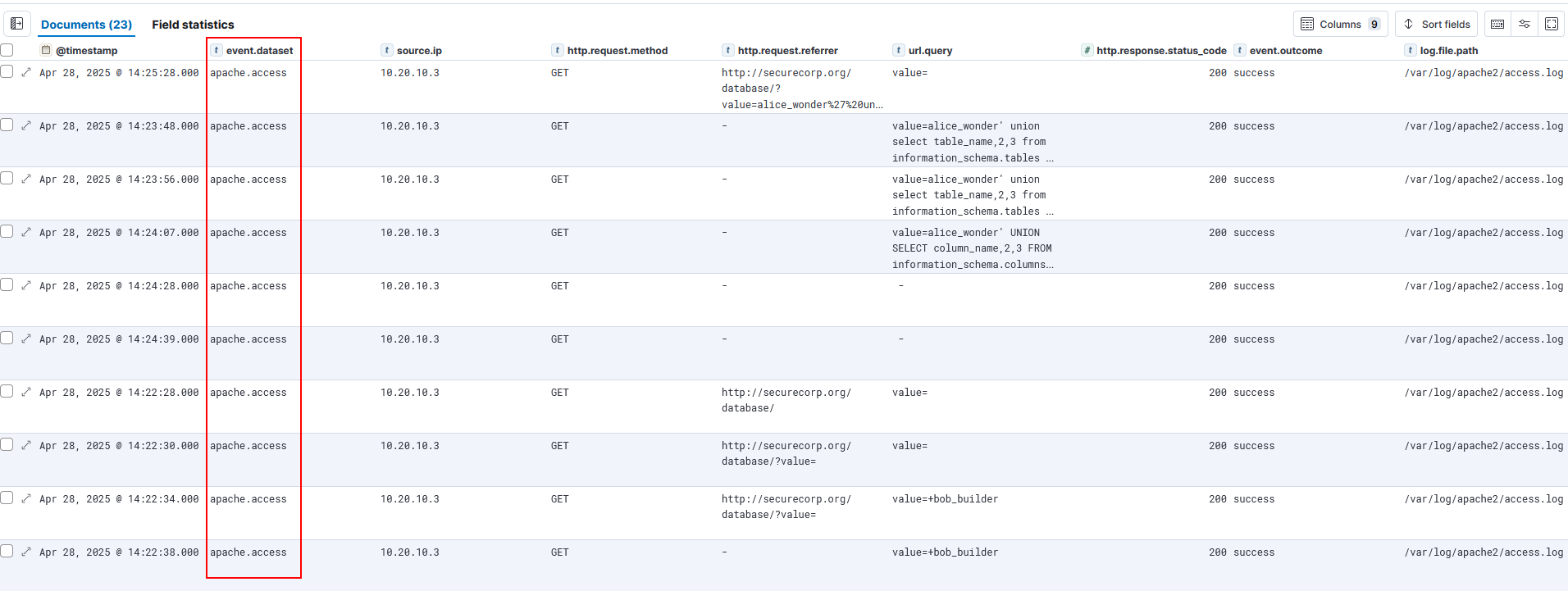
Step 2.1 – Identify Relevant Log Dataset (Apache Access Logs)
The first step is isolating the log dataset that contains HTTP events.
KQL Query
event.dataset: "apache.access"
Why this step matters
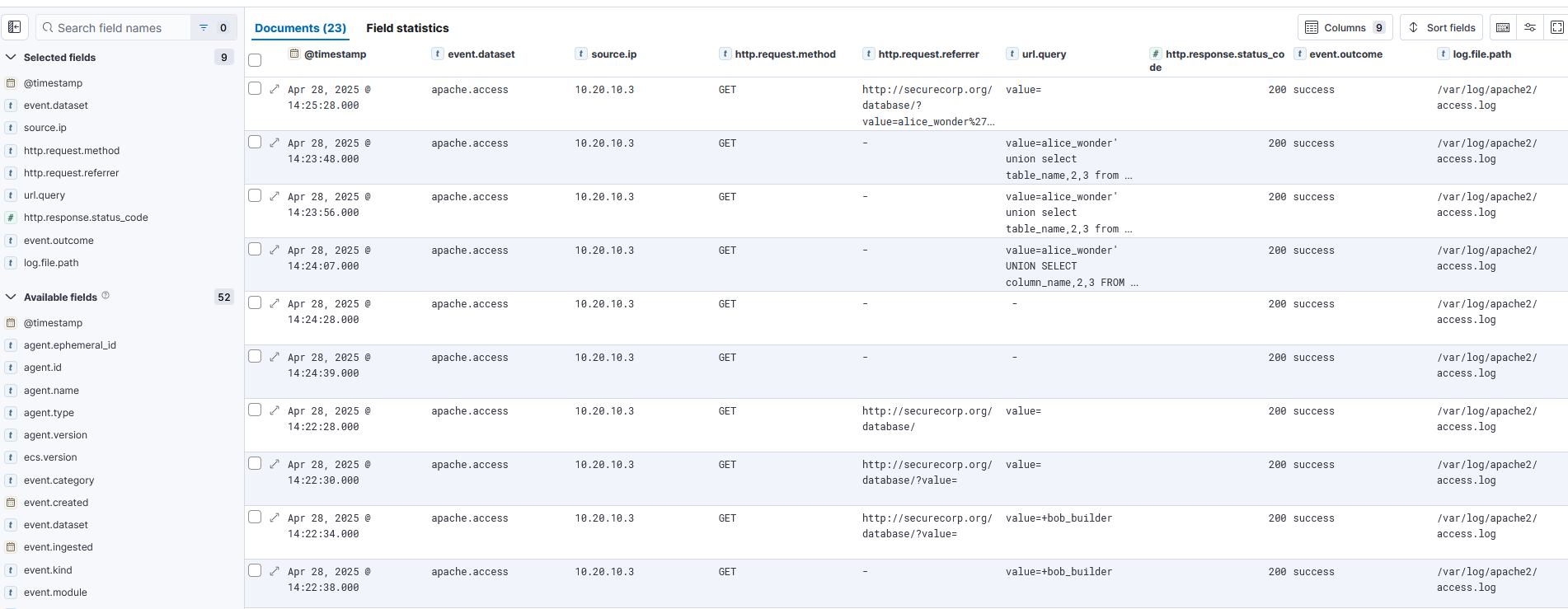
Attackers interact with the application through HTTP requests. Apache access logs provide:
- Client IP
- Targeted URI
- Authentication endpoints
- Response codes (401/403/404)
- Request methods (GET/POST)
- URL Query
- User agent strings
These fields are vital for pattern detection.
Step 2.2 – Validate the Alert
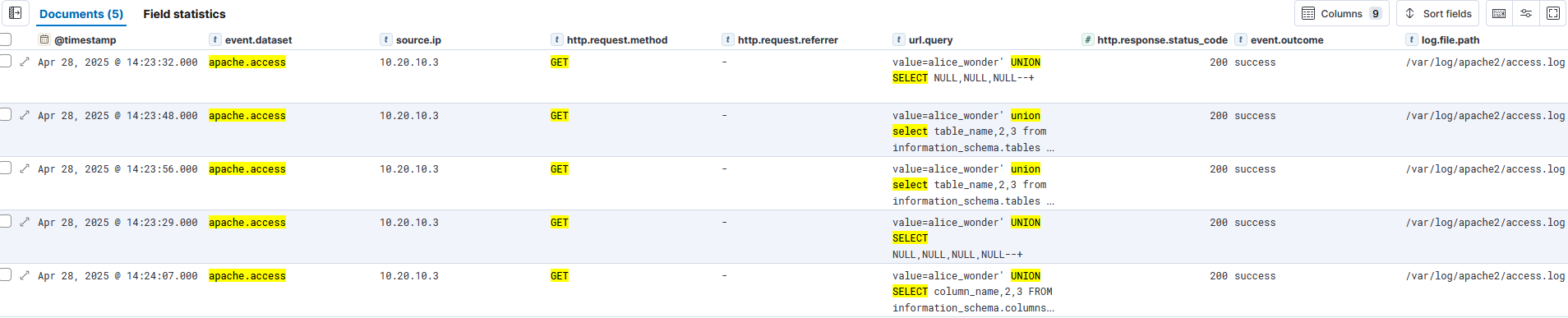
Confirm the alert is legitimate and the SQL keywords appear in GET requests.
Search Query
event.dataset: "apache.access" AND http.request.method: "GET" AND url.query: ("UNION" OR "SELECT" OR "INTO" OR "AND" OR "OR")
- Review matched log entries
- Confirm SQL keywords appear in URL query string
- Verify presence of encoding (e.g.,
%20,%27,%2B)
Step 2.3 – Scope and Pivot on Attacker IP
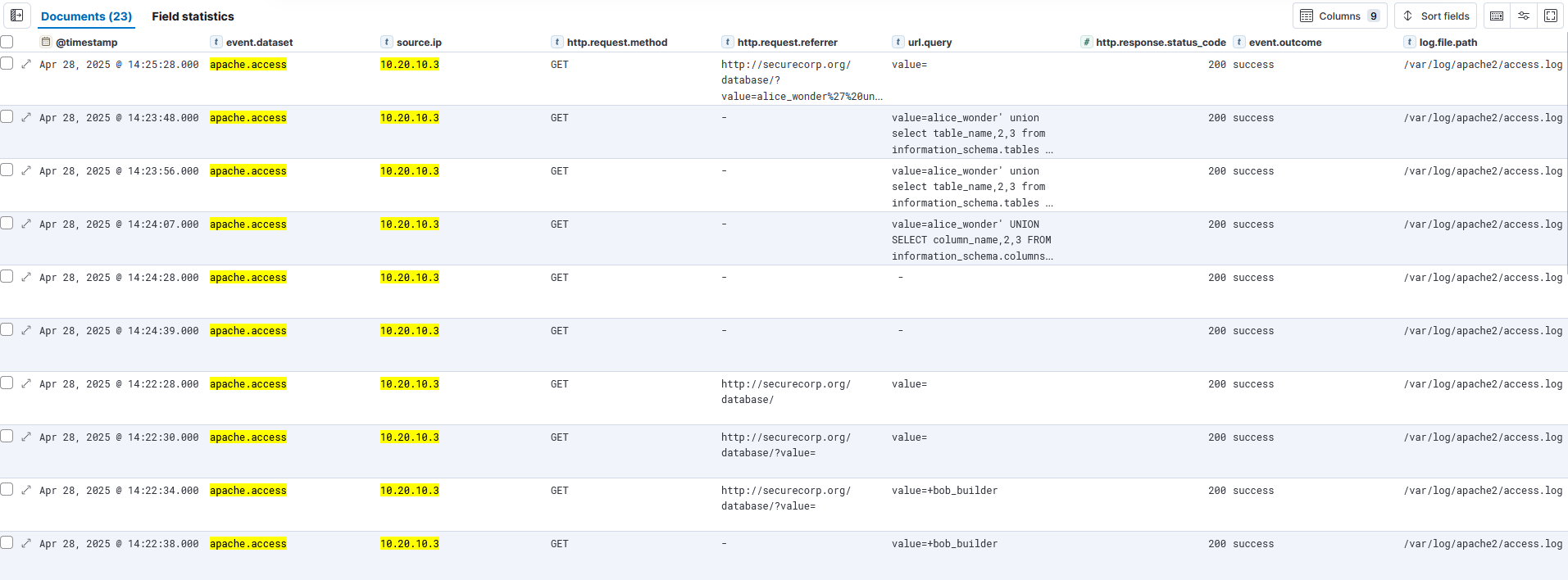
Identify whether the activity is widespread or isolated to one actor.
Search Query
event.dataset: "apache.access" AND source.ip: "10.20.10.3"
- Check number of requests from the attacker
- Identify patterns: frequency, bursts, enumeration behavior
- Look for multiple endpoints probed by attacker
Step 2.4 – Identify Targeted URLs and Parameters
Determine what part of the application the attacker is probing.
Search Query
event.dataset: "apache.access" AND source.ip: "10.20.10.3"
- endpoints targeted
- which parameters appear vulnerable
- whether attacker is mapping database schema
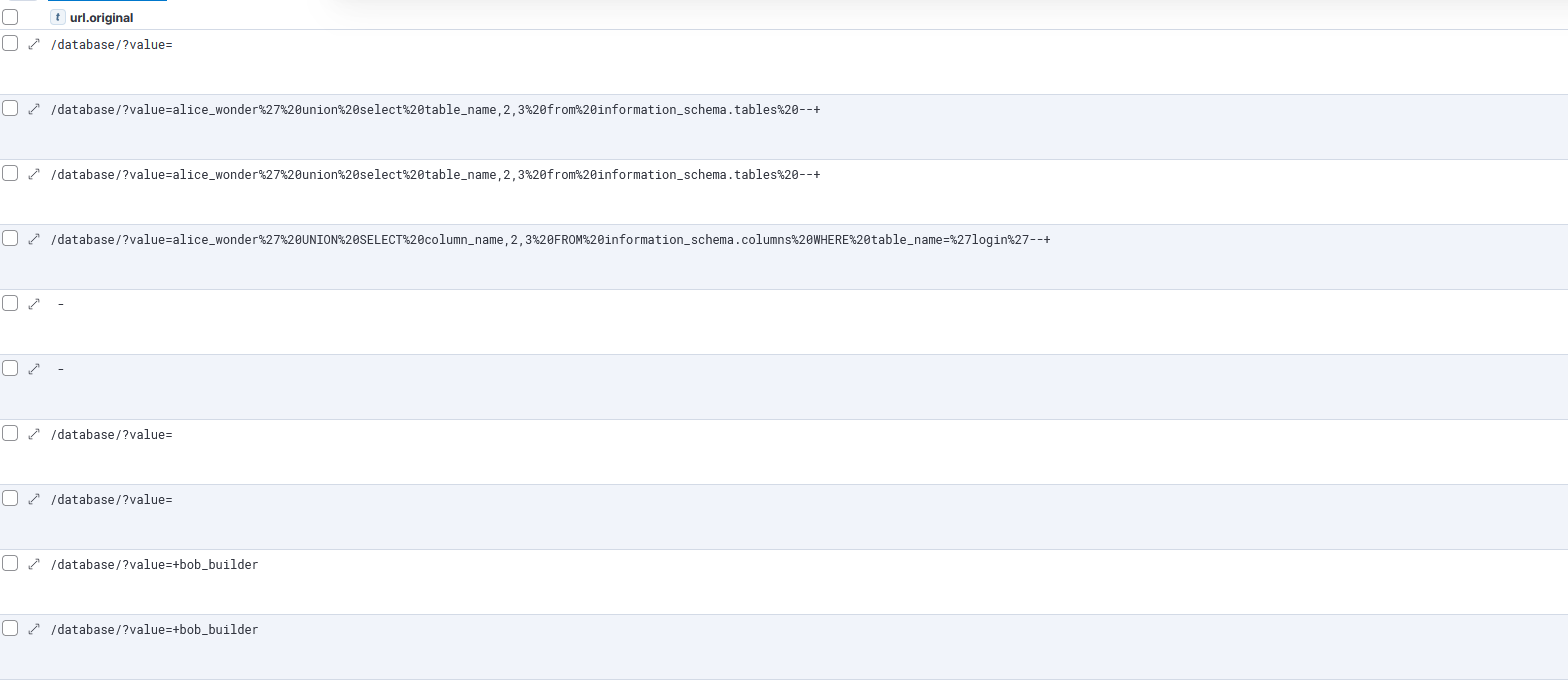
Step 2.5 – Extract URL-Encoded Payloads
SQLi payloads are often encoded using URL encoding.
Search Query
event.dataset: "apache.access" AND url.original.keyword :*%*
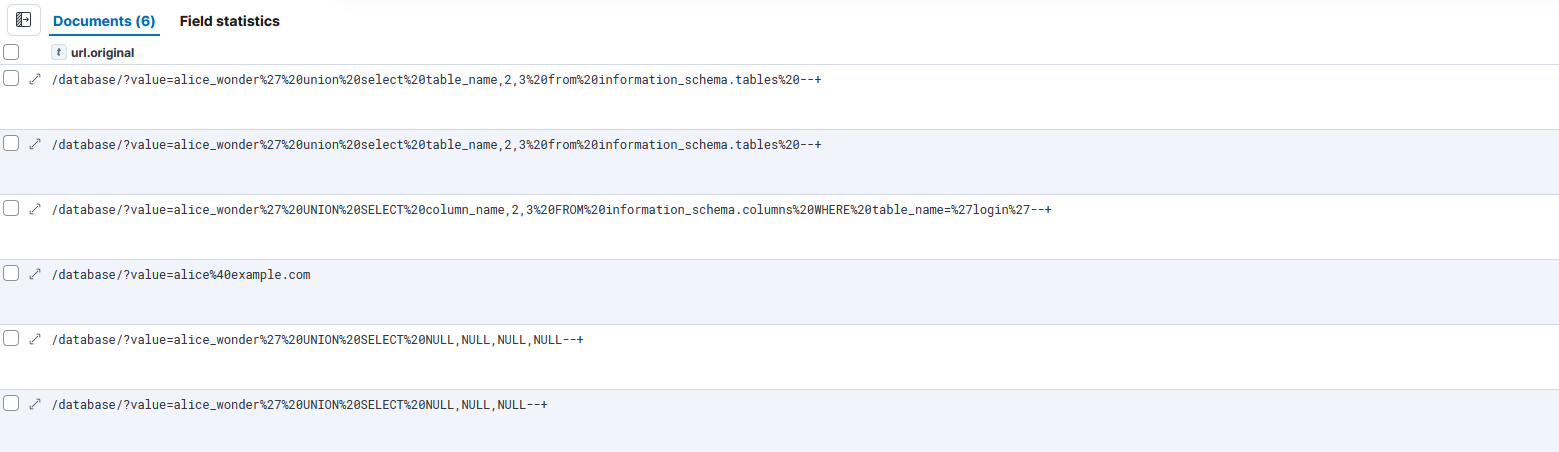
- Copy encoded URL parameters
- Paste into CyberChef
- Run URL Decode → UTF-8 Decode

Step 2.6 – Determine SQL Injection Attack Type
Look for UNION-based SQLi characteristics:
Indicators:
- presence of
UNION SELECT - multiple NULL placeholders
- enumeration statements:
information_schema.tablesinformation_schema.columns@@versionuser()database()
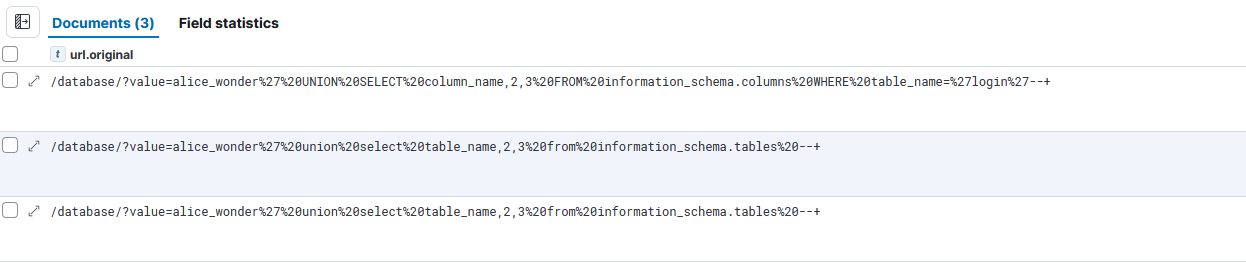
3. Final Conclusion
The investigation successfully validated the alert and confirmed that the observed activity was a targeted, multi-stage UNION-based SQL Injection (SQLi) attack executed through malicious GET requests in Apache access logs.
The attacker leveraged classic SQLi techniques—initial probing, column enumeration, schema discovery, and attempted data extraction—to manipulate backend SQL queries through vulnerable web parameters.
Through detailed log analysis, payload decoding, correlation of attacker behavior, and response code verification, it was determined that the adversary systematically attempted to enumerate database tables, columns, and version information using the UNION SELECT operator.
Decoded payloads revealed clear intent to extract sensitive metadata from the information_schema tables, indicating active reconnaissance and exploitation rather than benign or automated scanning.
Several indicators, including repeated attempts from the same malicious IP, encoded payloads consistent with known SQLi exploit chains, and positive (200 OK) server responses to certain malicious requests, strongly suggest that the targeted web application is vulnerable to SQL injection. This poses a serious risk of unauthorized data disclosure and compromise of backend database contents.