
Category: SOC - Investigation - PCAP
Detecting & Investigating Login Brute-Force Attacks Using ELK SIEM and PCAP Analysis
Brute-force attacks against public-facing login portals are among the most common entry points for attackers. In this investigation, we walk through a real-world simulation of a brute-force attack using:
- Apache access logs ingested into ELK SIEM
- HTTP request analysis
- Event correlation & timeline mapping
- Network forensics using PCAP
This write-up documents every step, reasoning, and acquired evidence that led to identifying the threat.
1. Preparing the Investigation Environment
Before diving into analysis, we identify our data sources:
| Source | Description | Purpose |
|---|---|---|
| Apache Access Logs (ELK) | Web server logs containing URL paths, client IPs, HTTP methods, status codes | Detect patterns of login attempts |
| PCAP File (Wireshark) | Raw captured network traffic | Validate login attempts & payloads |
| Kibana Discover / Dashboard | Visual interface for querying log data | Correlation, filtering, and timeline reconstruction |
2. Step-by-Step Investigation Workflow
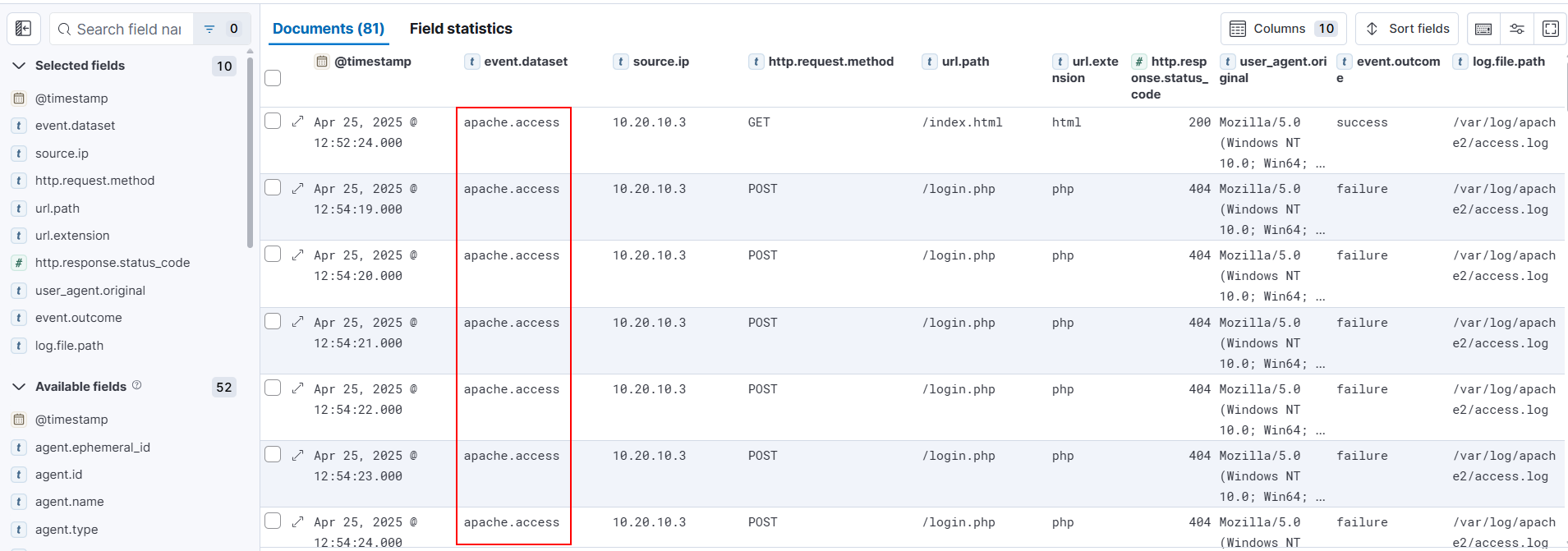
Step 2.1 – Identify Relevant Log Dataset (Apache Access Logs)
The first step is isolating the log dataset that contains HTTP events.
KQL Query
event.dataset: "apache.access"
Why this step matters
Attackers interact with the application through HTTP requests. Apache access logs provide:
- Client IP
- Targeted URI
- Authentication endpoints
- Response codes (401/403/404)
- Request methods (GET/POST)
- User agent strings
These fields are vital for pattern detection.
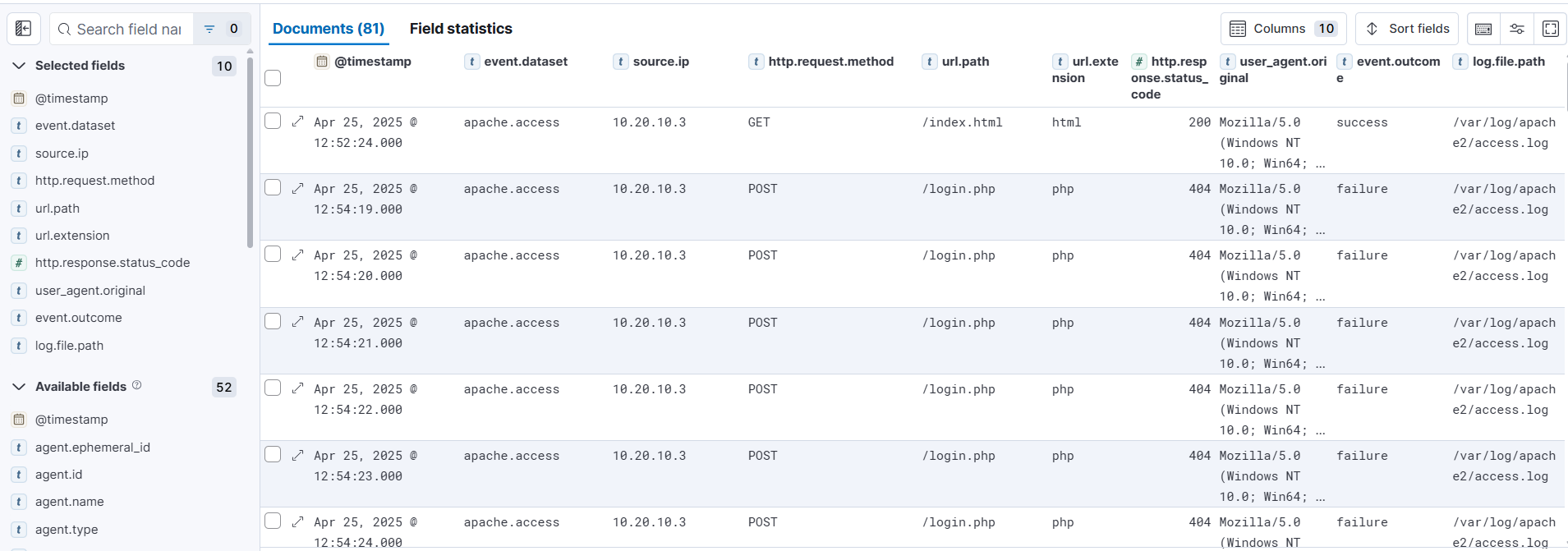 |
|---|
| Apache Logs in Kibana Discover |
Step 2.2 – Hunt for Authentication Endpoints
Next, we focus on URLs commonly used for login workflows.
KQL Query
url.path: *login* or url.path: *signin*
Data Acquired from this Stage
Example findings (replace with your actual logs):
| Source IP | HTTP Method | Path | Status |
|---|---|---|---|
| 10.20.10.3 | POST | /login.php | 404 |
Findings
- Repeated hits to
/login.php - Same client IP (
10.20.10.3) - High-frequency requests
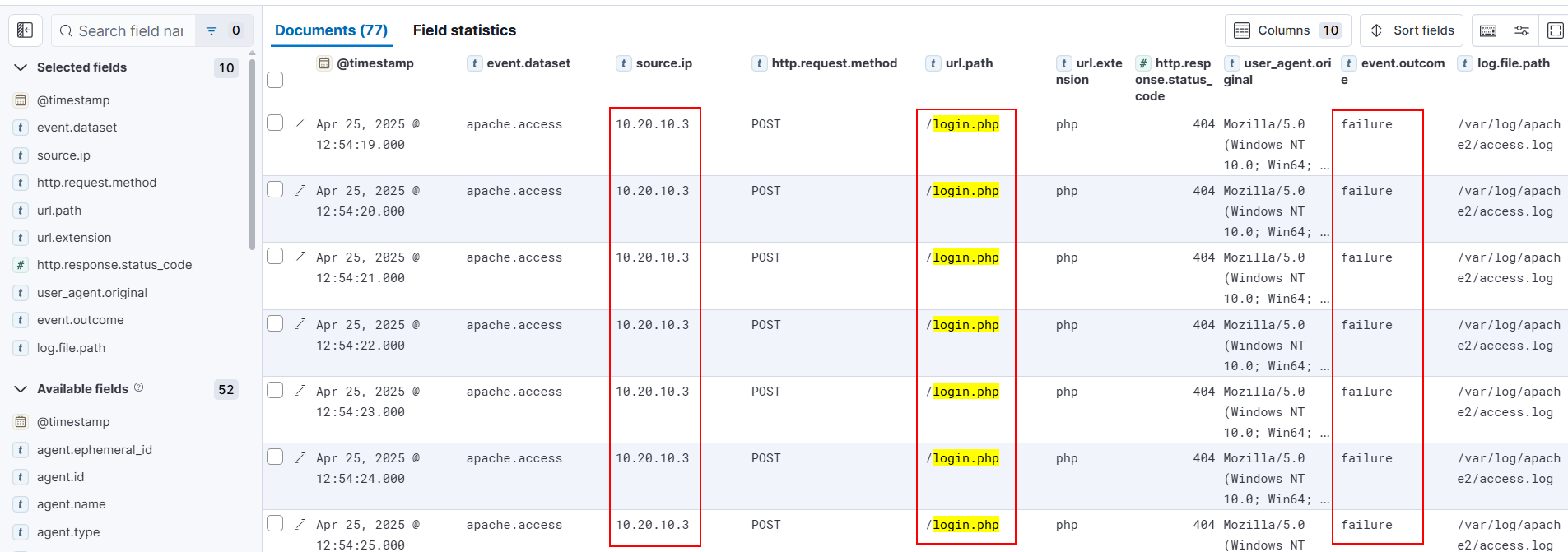 |
|---|
| Filtered Login Endpoint Logs |
Step 2.3 – Correlate With Failed Attempts (Brute-Force Signature)
Attackers rarely succeed on the first attempt. A cluster of failed POST requests is a major red flag.
KQL Query
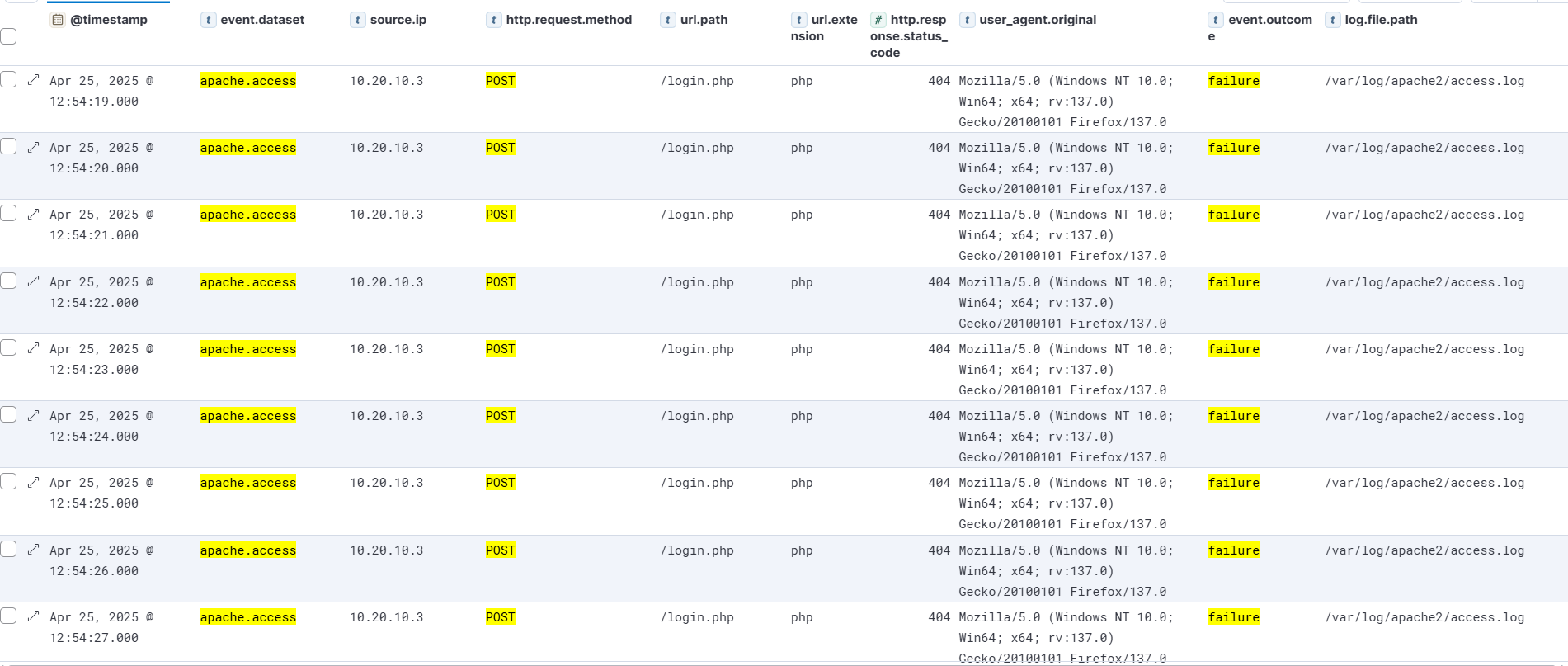
event.dataset: "apache.access"
and http.request.method: "POST"
and event.outcome: "failure"
and (http.response.status_code: 401 or 403 or 404)
What We’re Looking For
- Sudden spike of POST requests
- Same IP hitting same endpoint
- Short time interval (seconds)
- Failed responses
Acquired Evidence
Example extracted from logs:
| Time | Source IP | Method | URI | Status | User-Agent |
|---|---|---|---|---|---|
| Apr 25, 2025 @ 12:54:19.000 | 10.20.10.3 | POST | /login.php | 404 | Mozilla/5.0 (Windows NT 10.0; Win64; x64; rv:137.0) Gecko/20100101 Firefox/137.0 |
- Sequential timestamps → brute force
- Continuous failure → incorrect credentials
 |
|---|
| Failed POST Request Logs |
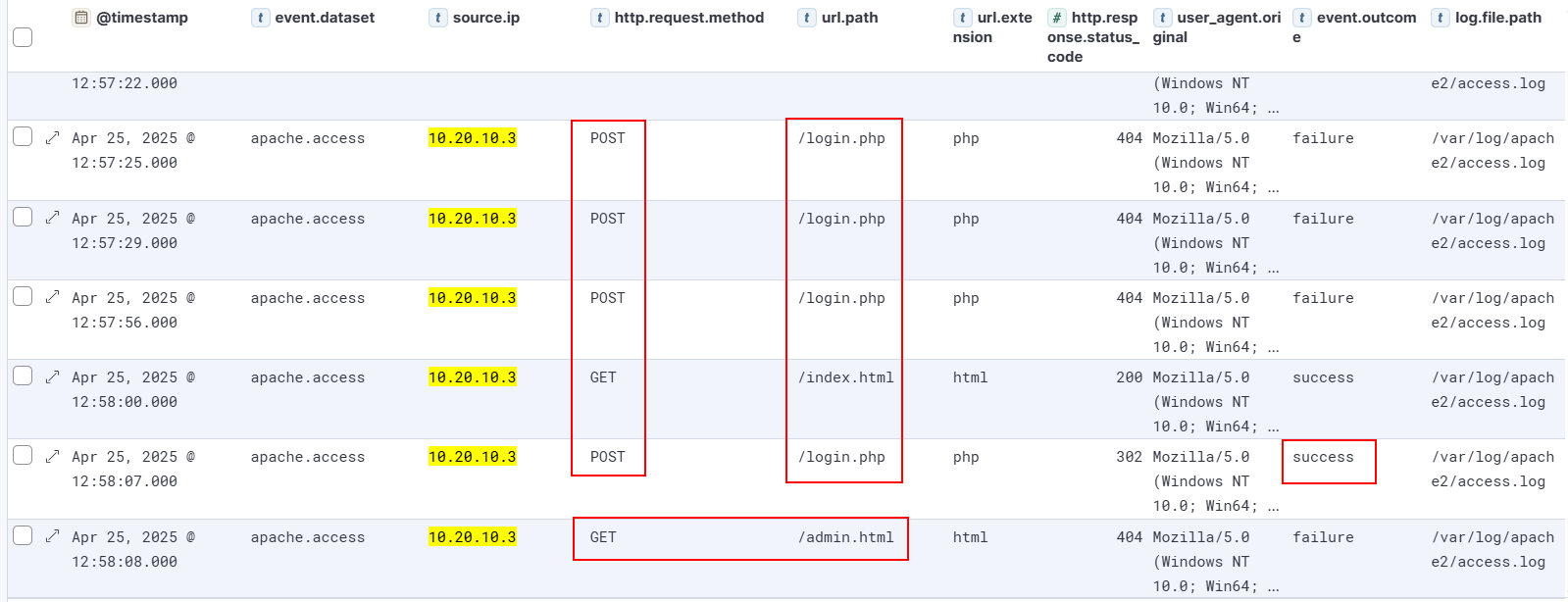
Step 2.4 – Identify Attack Patterns (IP-Level Investigation)
We pivot into analyzing attacker behavior per IP:
Kibana Query
source.ip: "10.20.10.3"
Behavior Observed
- More than 100+ requests in under 1 minute (example)
- Target focused only on
/login.php
 |
|---|
| Source IP Activity Summary |
3. Network Forensics Validation (PCAP)
Apache logs show behavior — PCAP reveals content.
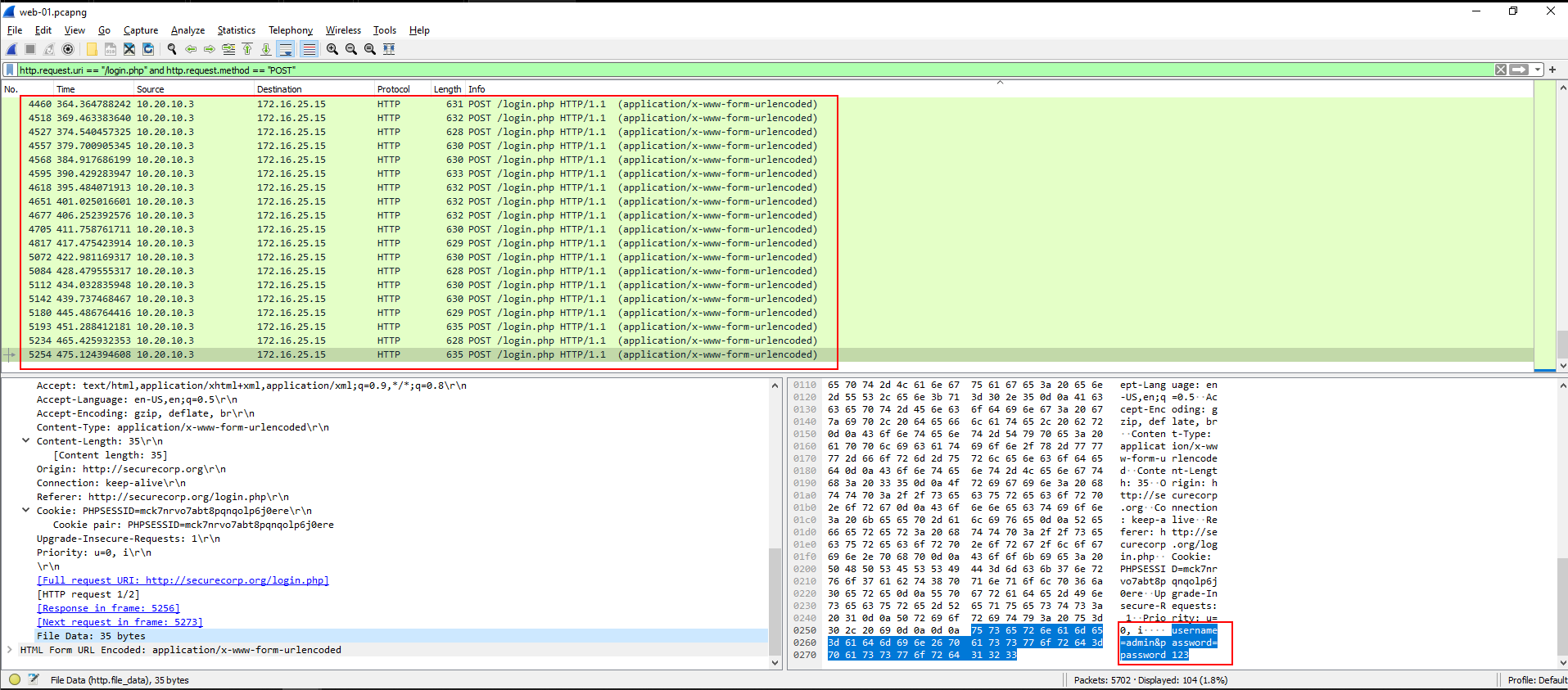
We load the provided PCAP in Wireshark.
Wireshark Filter
http.request.uri == "/login.php" and http.request.method == "POST"
What We Found in Packets
- POST credentials attempted
- Destination: 172.16.25.12 (web server)
- Source: 10.20.10.3
- Multiple sequential packets with login attempts
- Payload fields such as:
- username=admin
- password=password123
 |
|---|
| Wireshark POST Request Capture |
Correlation Summary (Full Evidence)
| Indicator | Observation | Meaning |
|---|---|---|
| Endpoint | /login.php |
Authentication page |
| HTTP Method | POST | Credential submission |
| Status Codes | 404 failures | Incorrect login attempts |
| Source IP | 10.20.10.3 | Attacker host |
| Frequency | Rapid, sequential POST | Brute-force signatures |
| PCAP | Repeated POST payloads | Confirms attack activity |
Final Conclusion
This investigation confirms a credential brute-force attack against a PHP-based login form.
Key takeaways:
- ELK SIEM pinpointed pattern anomalies through filtering and correlation.
- Apache access logs revealed repeated POST failures.
- User-agent analysis identified automation indicators.
- IP-level review confirmed a single-source attack.
- PCAP analysis validated the packet-level brute-force attempts.